
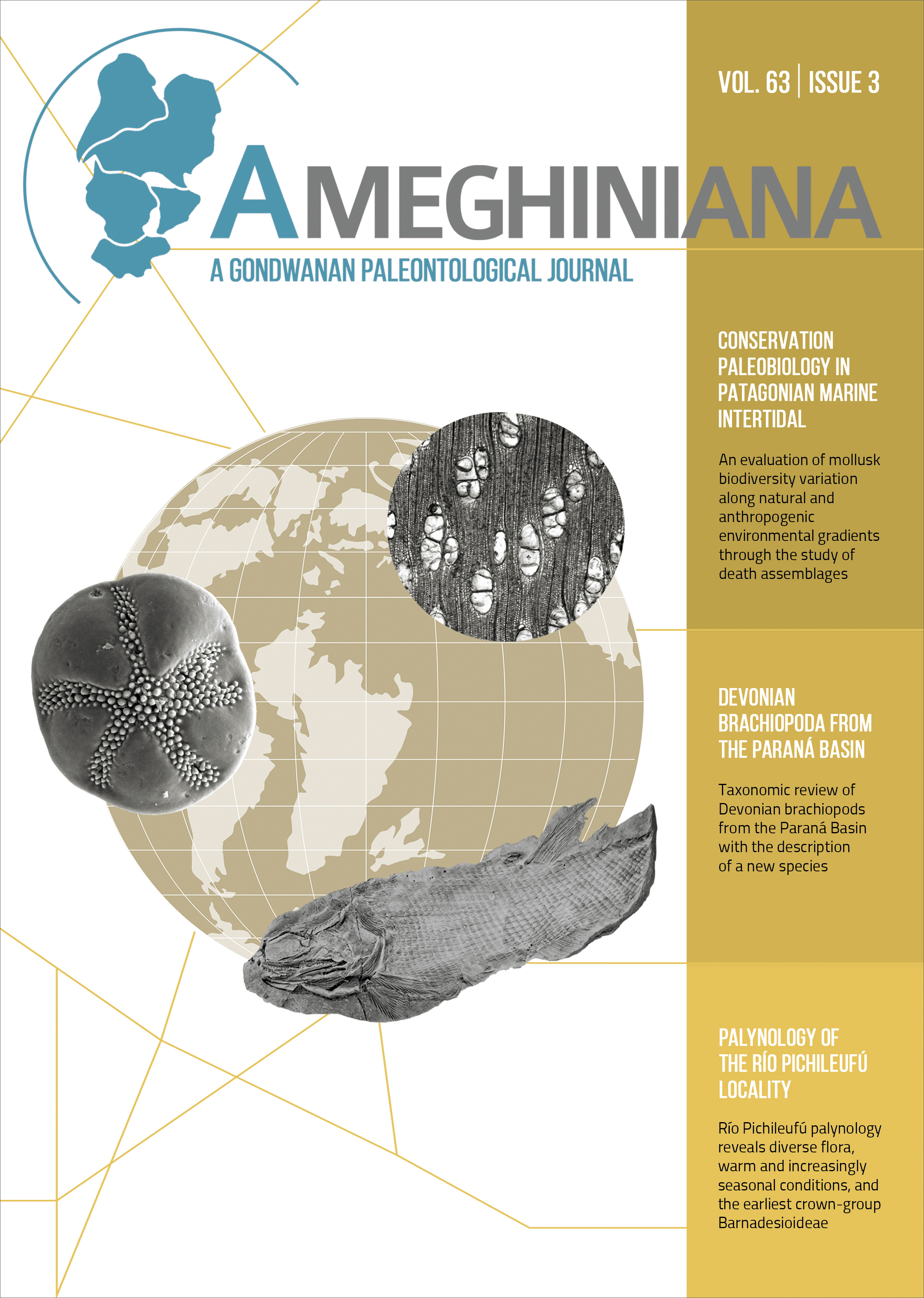
Conservation paleobiology of intertidal molluscs: detecting human impacts in San Antonio Bay, northern Patagonia
DOI:
https://doi.org/10.5710/Keywords:
Molluscan shell assemblages, Taphonomic fidelity, Environmental gradients, Eutrophication, Benthic biodiversity, Argentine Patagonia, Conservation paleobiology, Multivariate analysisAbstract
Based on quantitative sampling and comprehensive multivariate analyses, changes in the biodiversity of molluscan death assemblage were assessed in relation to natural (subaerial exposure and hypersalinity) and anthropogenic (eutrophication) environmental gradients. In addition, a taphonomic fidelity assessment was performed using a presence/absence matrix. The results show that species abundances of death assemblages accurately reflect environmental gradients, particularly the distance to the bay stress derived from the distance to the bay, which determines variations in aerial exposure, salinity, and temperature. More distal communities exhibit lower species richness and dominance of Heleobia australis, whereas proximal ones are more diverse and even. Differences between channels are significant but moderate, with Agathistoma patagonicum, a well-known intertidal to shallow subtidal herbivore being abundant where anthropogenic eutrophication occurs. Beta diversity analysis suggests that death assemblages retain information on pre- and post-impact community configurations, from the unexpectedly high contribution of a proximal site in the eutrophicated channel, and a higher influence of turnover in the same channel, in comparison with the non-impacted, in which a nestedness pattern seems to explain the reduction of alpha diversity upstream. Based on a presence/absence comparison, death assemblages differ from the living community, although both follow the environmental gradients. Molluscan death assemblages thus provide effective, inexpensive, and non-invasive tools for conservation biology applications, enabling reconstruction of the recent history of benthic ecosystems and early detection of anthropogenic alterations, thereby offering key information for designing conservation strategies in Patagonian marine environments.
Downloads
Published
Issue
Section
License
Authors publishing in Ameghiniana have the option of making their article freely available online. Authors opting for the Open Access must pay a fee of $300 (US dollars) to cover article-processing costs and to ensure the article is made open access. Please contact the Production Team after the acceptance of your manuscript if you are interested in making your article Open Access. This option implies by default a license Creative Commons Attribution Non-Commercial-NoDerivs License (CC BY NC ND). If your funding institution requires a different licensing option please communicate this to the Production Team after the acceptance of your manusctipt.


